
In our latest Number Cruncher, we looked at three Canadian companies that currently stand out across for their valuation, stability and resilient profitability: Alimentation Couche-Tard Inc. (ATD-T), CCL Industries Inc. (CCL.B-T) and CGI Inc. (GIB.A-T).
We will look at each of these companies in-depth through the CPMS engine to better understand the characteristics that made them stand out in their respective strategies.
Alimentation Couche-Tard Inc. (ATD:TSX)
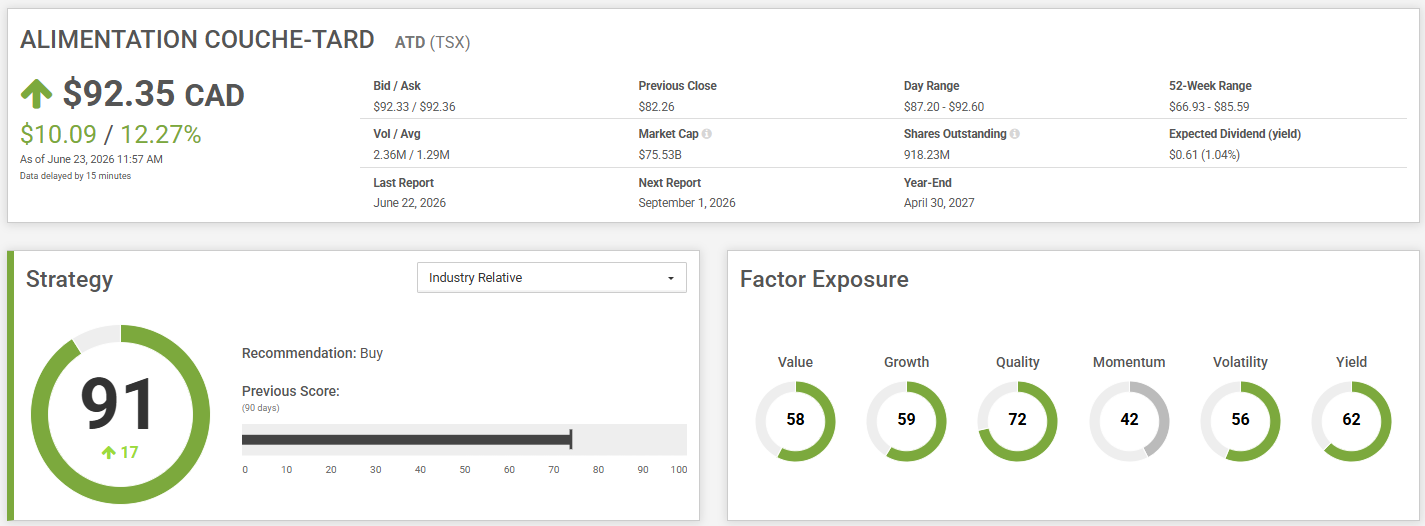
Starting with Alimentation Couche-Tard, the company scores very strongly under CPMS’s Industry Relative strategy, with an overall strategy score of 91. The score has improved by 17 points over the past 90 days, suggesting that the company’s relative positioning has strengthened meaningfully.
The Industry Relative strategy is designed for investors seeking industry diversification in mid to large-cap companies. The strategy ranks and screens stocks on both growth and value criteria measured against each stock’s industry group. Earnings momentum, estimate revisions and earnings surprises are also emphasized.
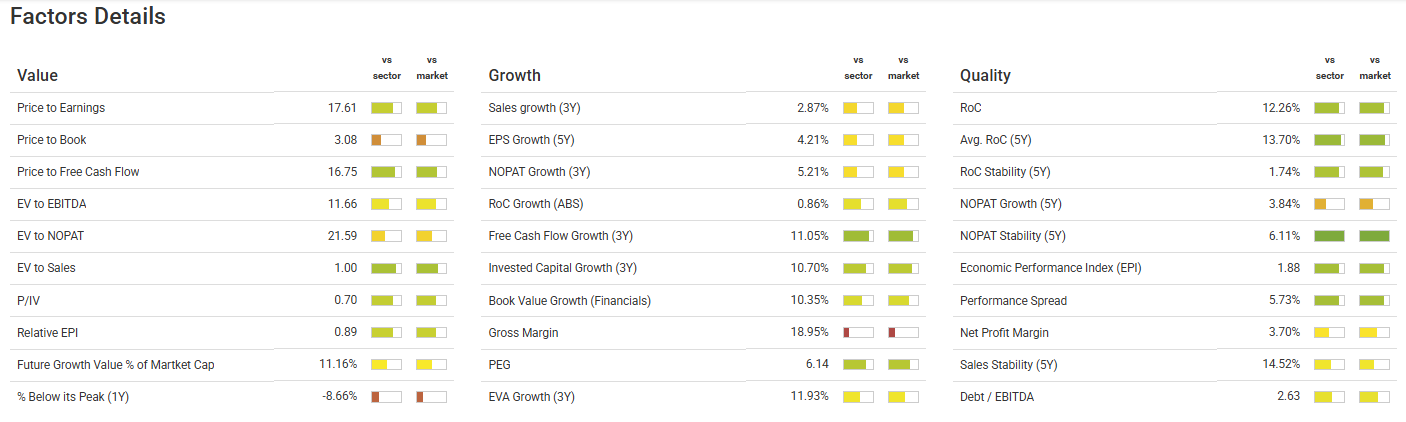
Looking more closely at the factor details, ATD trades at a price-to-earnings ratio of 17.61, price-to-free-cash-flow (P/FCF) of 16.75 and EV/EBITDA of 11.66. These valuation levels suggest that the stock is not a deep value opportunity but remains reasonable when considered alongside its quality profile and operating consistency.
The company also shows steady growth characteristics. Sales growth over three years stands at 2.87 per cent, EPS growth over five years is 4.21 per cent, and free cash flow growth over three years is 11.05 per cent. Invested capital growth of 10.70 per cent over three years further points to continued business expansion.
On the quality side, ATD reports a return on capital of 12.26 per cent, a five-year average return on capital of 13.70 per cent and a performance spread of 5.73 per cent. Holistically, these metrics help explain why ATD ranks highly in the Industry Relative strategy. The stock combines reasonable valuation, steady cash-flow growth and strong quality characteristics, though the lower momentum score is worth monitoring.
CCL Industries Inc. (CCL.B:TSX)
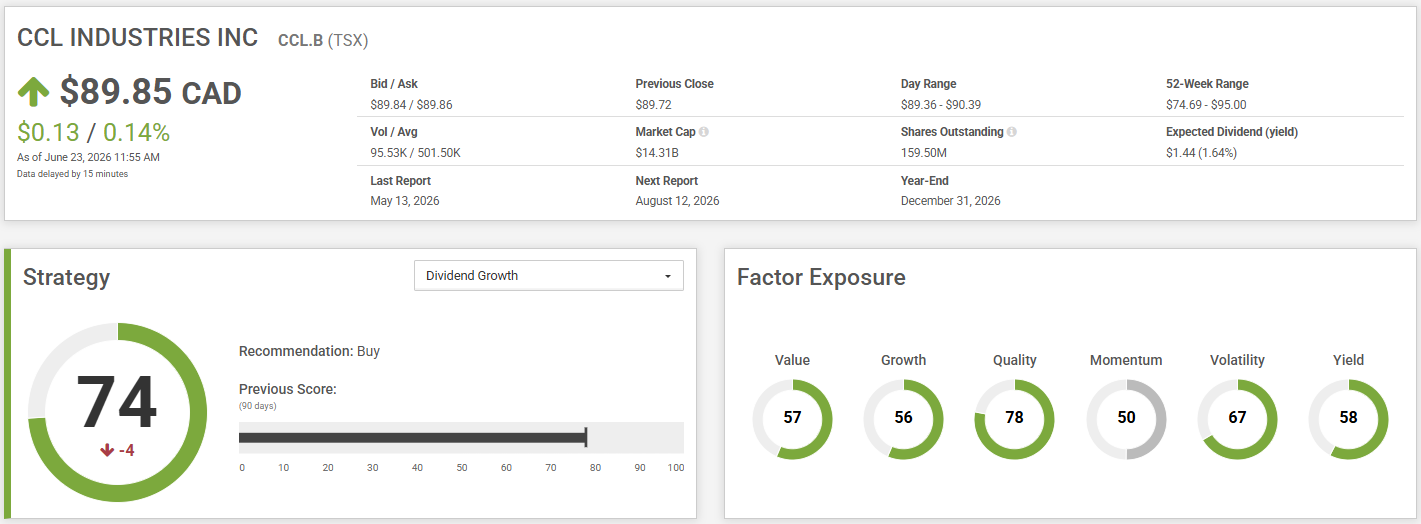
Turning to CCL Industries, the company stands out under CPMS’s Dividend Growth strategy, with a strategy score of 74. The score has declined by 4 points over the past 90 days, reflecting some recent weakness, but the company continues to rank well within a dividend-growth framework.
The CPMS Canadian Dividend Growth Strategy is suited for income-oriented investors seeking profitable companies that are growing their dividends. The strategy emphasizes high expected dividend yields and dividend growth, while also placing importance on cash-flow momentum and return on equity.
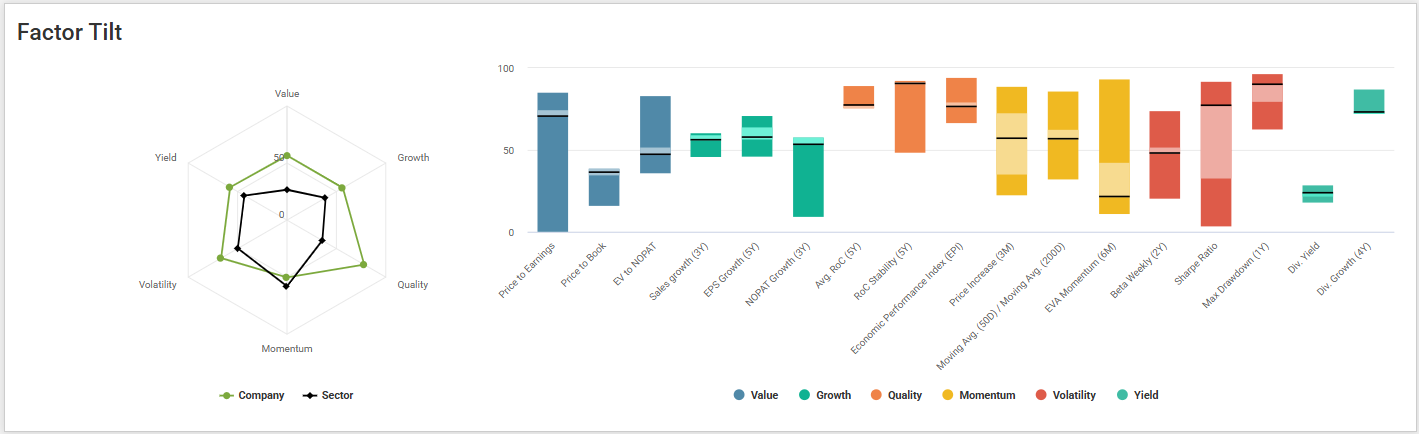
Looking at the factor tilt, the company compares favorably against its sector across several factor categories, particularly Quality, where it shows stronger scores in measures such as return on capital, return on capital stability and economic performance. Its Value exposure is also supportive, with valuation measures such as price-to-earnings, price-to-book and EV/NOPAT positioned attractively relative to the sector.
Growth is more mixed, with solid sales and EPS growth readings, but weaker NOPAT growth. Momentum remains a softer area, as shown by weaker price increase and moving average indicators, while Volatility is elevated due to recent stock weakness and drawdown. Overall, the chart suggests that CCL’s appeal is driven mainly by valuation and quality, while recent momentum and volatility remain the key areas to monitor.
CGI Inc. (GIB.A:TSX)
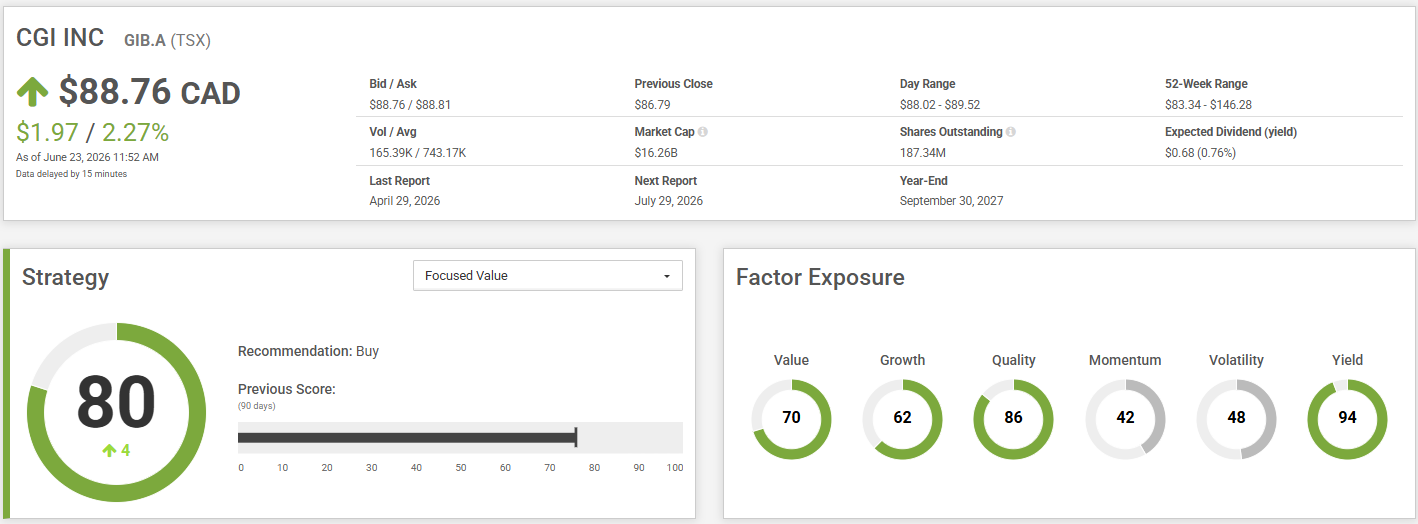
Lastly, CGI Inc. stands out under CPMS’s Focused Value strategy, with a strategy score of 80. The score has improved by 4 points over the past 90 days, indicating that the company’s relative attractiveness has strengthened within the model.
The CPMS Focused Value Strategy is designed for investors seeking undervalued yet high-potential and financially stable stocks that may eventually be rewarded by the market. The strategy focuses on core value parameters such as price-to-earnings, price-to-sales, price-to-cash-flow and price-to-book value. Importance is also placed on earnings estimate revisions, while stocks are screened for financial stability and liquidity.
CGI’s factor exposure is particularly strong in Yield and Quality. The company scores 94 in Yield, 86 in Quality, 70 in Value and 62 in Growth. Momentum is weaker at 42, this suggests that CGI’s investment case is driven primarily by value, stability and shareholder-return characteristics rather than recent price momentum.
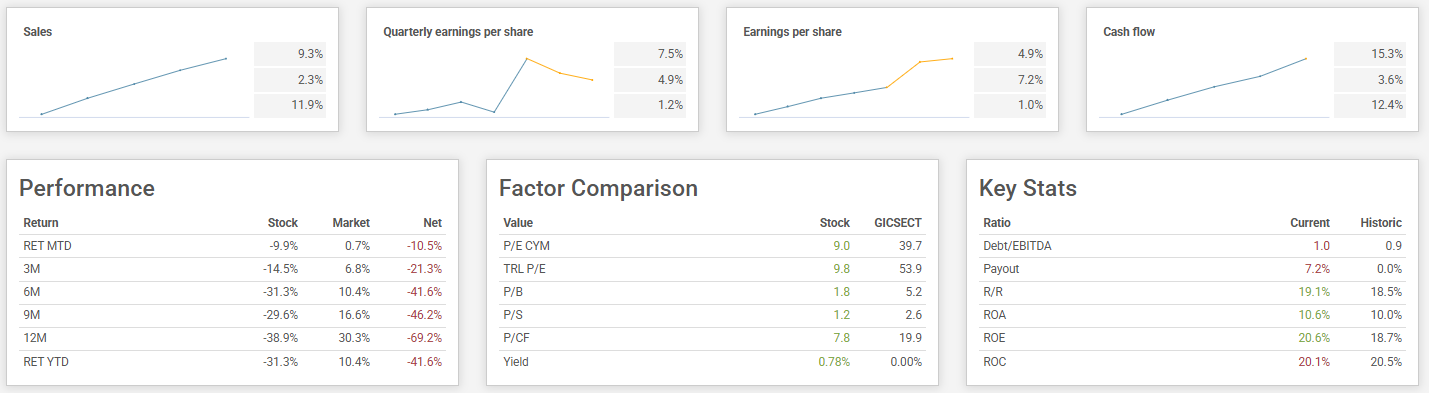
From a valuation perspective, CGI appears attractive relative to its sector. The stock trades at a current-year P/E of 9.0 times compared with 39.7 times for its GICS sector, and a trailing P/E of 9.8 times compared with 53.9 times for the sector. Its price-to-book ratio of 1.8, price-to-sales ratio of 1.2 and price-to-cash-flow ratio of 7.8 are also meaningfully below sector levels. However, recent performance has been weak. The stock is down 9.9 per cent month-to-date and has declined 38.9 per cent over 12 months, significantly underperforming the broader market over both periods.
Despite the negative price momentum, CGI’s profitability metrics remain supportive. Return on equity is 20.6 per cent, return on assets is 10.6 per cent and return on capital is 20.1 per cent. Debt also appears manageable, with debt-to-EBITDA of 1.0. Overall, CGI looks like a quality and dividend-growth candidate trading at discounted valuation levels, although investors should weigh the recent share-price weakness carefully.
Conclusion
Our analysis of Alimentation Couche-Tard, CCL Industries and CGI highlights how different CPMS strategies can identify attractive Canadian companies through distinct factor profiles.
ATD stands out under the Industry Relative strategy, supported by strong quality metrics, reasonable valuation and improving strategy momentum. CCL Industries ranks well under the Dividend Growth strategy, combining strong profitability and discounted valuation metrics, despite weaker recent stock performance. CGI fits the Focused Value strategy, with particularly strong quality, value and shareholder-yield characteristics. While each company presents a different investment profile, all three demonstrate characteristics that may appeal to investors using a disciplined quantitative framework.
In conclusion, the CPMS engine provides a useful framework for identifying companies that align with specific investment objectives. However, investors should still consider individual risk tolerance, portfolio construction and company-specific fundamentals before making any investment decision.
Anuj Anand, MBA, LLM is an Investment Analyst at Inovestor.