
In the last Number Cruncher, we looked at Canadian Technology companies that have fundamental strength, however, faced price-momentum headwinds.
Topicus.com (TOI-V)
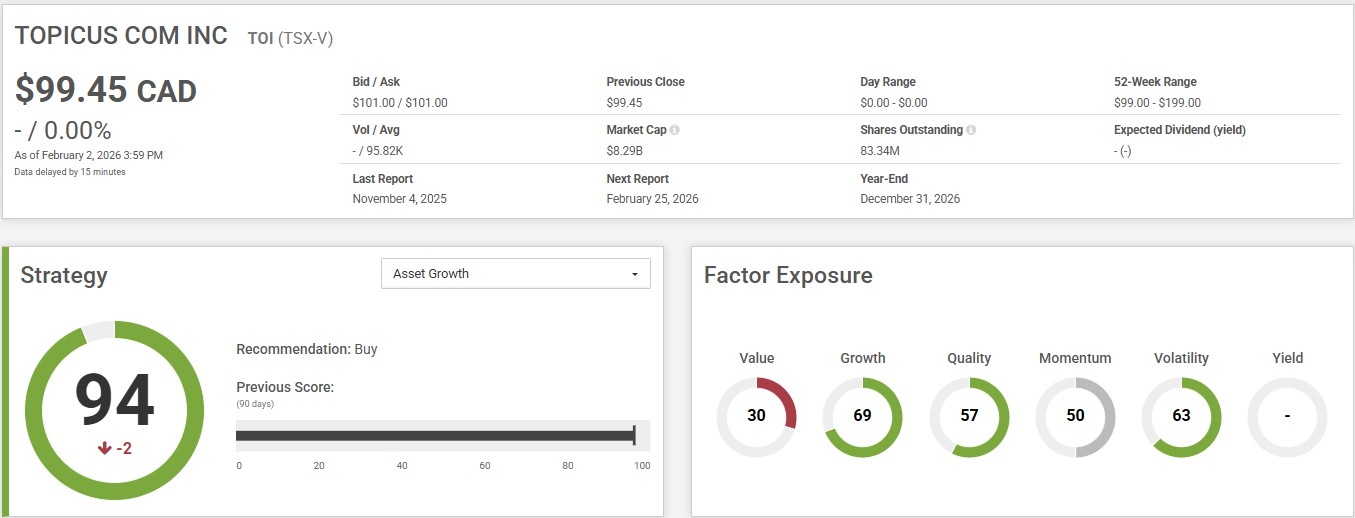
Topicus stands out in Growth with a score of 69. Therefore, it has a great score in CPMS’s Canadian Asset Growth Strategy. It is suited for investors seeking high growth rates through stocks with high reinvestment rates. The strategy emphasizes stocks with high trailing and expected reinvestment rates, with high earnings estimate revisions, quarterly sales momentum and earnings surprise.
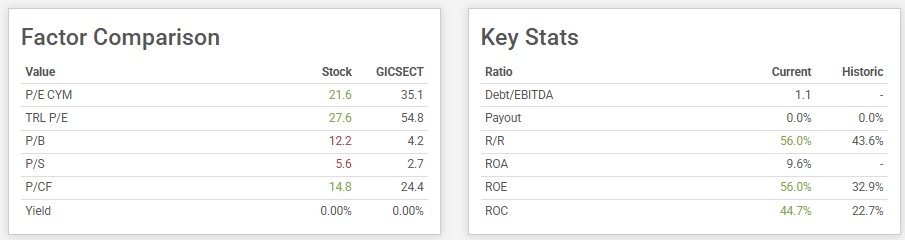
The factor comparison section showcases the company’s better metric when it comes to valuations compared to its sector. The lower P/E and P/CF compared to its sector makes it undervalued and attractive due to its efficient cash generation compared to its sector.
Lightspeed Commerce (LSPD-T)
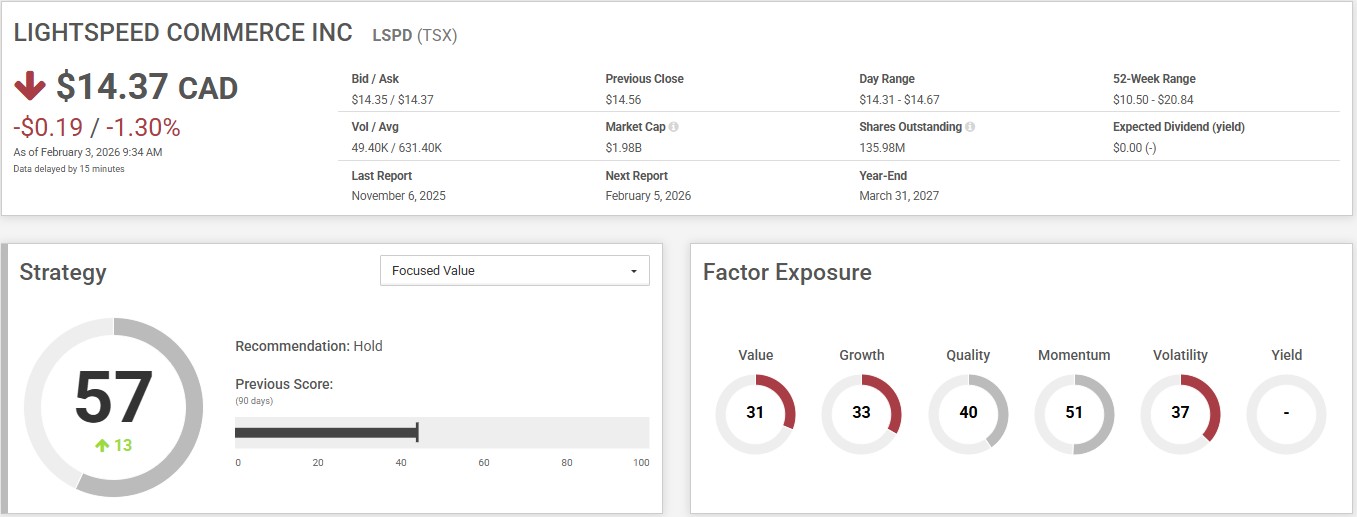
Lightspeed has a Momentum score of 51, indicating its momentum ability ranking compared to its sector and the overall market. CPMS helps determine the most suitable strategy for a stock, and Lightspeed’s saw strong improvement in the Focused Value strategy. The CPMS Focused Value Strategy is designed for investors seeking undervalued yet highly potential and financially stable stocks which are eventually rewarded by the market. The strategy starts with CPMS Canadian universe focusing on core value parameters like Price to Earnings, Price to Sales, Price to Cashflow and Price to Book Value to identify undervalued stocks. Importance is also placed on stocks with high Earnings Estimate Revisions.
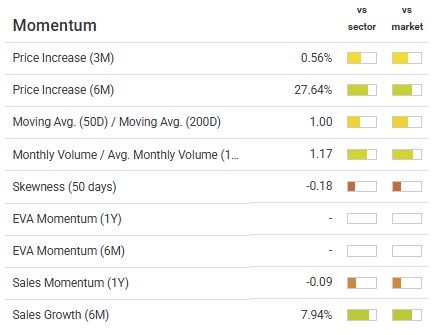
CPMS’s Factor Details tool provides a compelling view of the company stock, highlighting its solid positioning in momentum factors. Diving into individual metrics, we see that Lightspeed had a 27.64% price increase and its 50/200 Moving average at 1, indicating the stock saw a bottom and a reversal to catch up to the 200 moving average. Additionally, the company saw a strong sales growth in over the past six months. However, the negative skewness (-0.18) showcases sharper downside pullbacks along with greater volume than the average monthly volume indicates higher volatility, which calls for caution for risk averse investors.
Constellation Software (CSU-T)
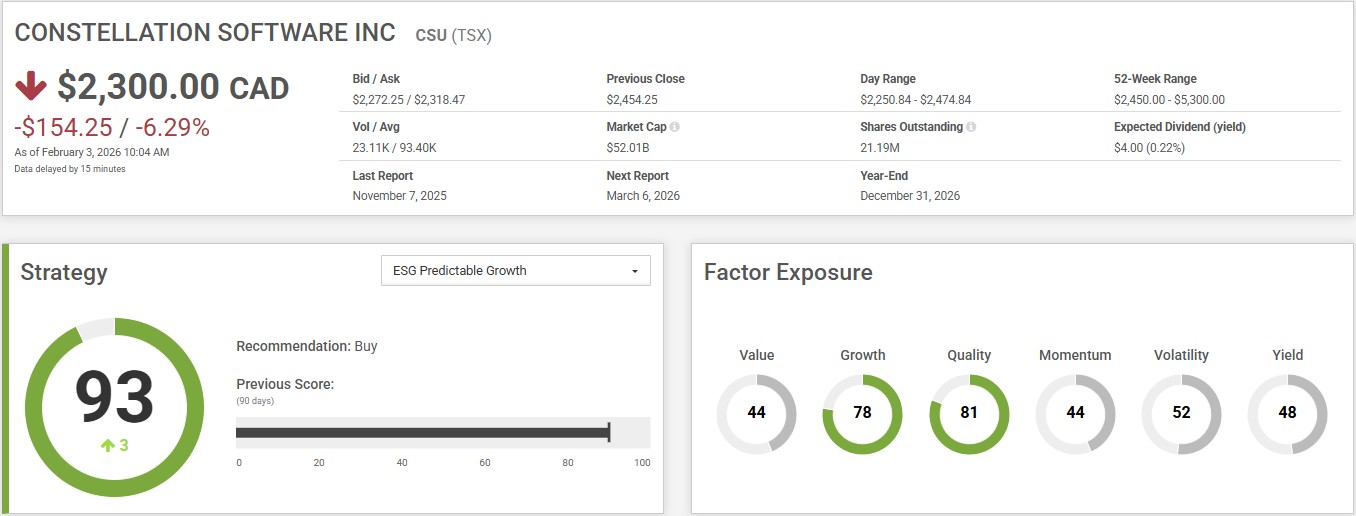
Constellation Software stands out in Quality and Growth, with a score of 81 and 78 in those categories. Therefore, it has a great score in CPMS’s ESG Predictable Growth. The Predictable Growth strategy is designed for sustainability-conscious, conservative investors seeking growth at a reasonable price. The strategy looks for ESG risk-screened stocks with good earnings value, whose book values are growing but whose earnings have low levels of variability. It also looks at earnings surprise and quarterly earnings momentum.
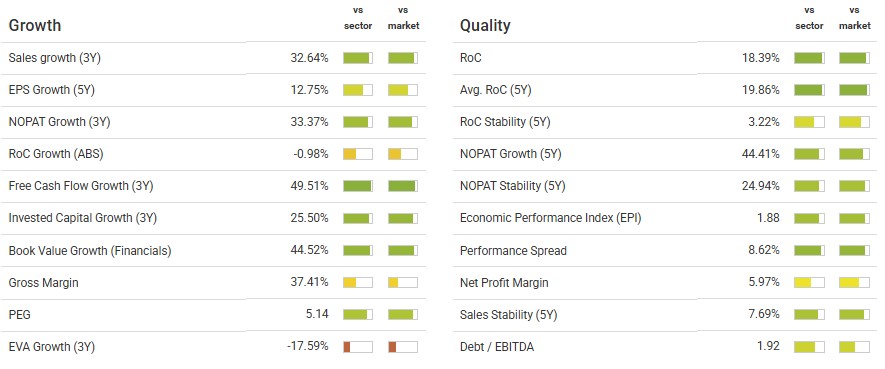
A review of Constellation’s key metrics highlights why the company has a good quality score. In CPMS’s Factors Details section, the company demonstrates a Avg ROC (5Y) of 19.86% and a NOPAT growth(5Y) of 40.7%, underlining its consistent earnings and profit generation. Additionally, an Economic Performance Index of 1.88 reflects company’s ability to create economic value, achieving a return on capital that is 1.88 times its cost of capital.
By leveraging the CPMS engine, investors can screen and identify stocks that align with specific investment criteria. In this analysis, we focused technology stocks backed with fundamental strength that has not yet manifested in their price. Topicus.com, Lightspeed Commerce and Constellation Software all demonstrated these key metrics, emphasizing positive sales growth along with growing momentum as explained in our number cruncher blogpost. While these stocks offer momentum for investors to ride with the rising tide, however, they must be willing to accept the inherent risks associated with momentum investing.
In conclusion, the CPMS engine provides a valuable tool for identifying high-potential stocks that align with specific investment strategies. By focusing on strong price momentum and earnings growth, investors can make more informed decisions. However, it is essential to consider individual risk tolerance and investment objectives before making any commitments. A well-balanced approach that incorporates both fundamental analysis and strategic insights from CPMS can help investors navigate market uncertainties and optimize portfolio performance.